Established in 1994, Rural Awareness and Development Organization–Nepal (RADO-Nepal) is a non-governmental, non-political, and non-profit social development organization dedicated to building resilient and inclusive communities. Headquartered in Hetauda, Makawanpur District, it is affiliated with the Social Welfare Council, NGO Federation of Nepal, and global and national networks including the Sanitation and Water for All (SWA) Global Partnership and the National Disaster Resilient Network (NDRNet).
RADO-Nepal works to address the root causes of poverty and social injustice by promoting the active participation and empowerment of poor and marginalized communities. Its integrated interventions focus on education, public awareness, good governance, human rights, child safeguarding, gender equality and social inclusion (GESI), disaster risk reduction and climate change adaptation (DRR/CCA) through nature-based solutions, water, sanitation and hygiene (WASH), and sustainable infrastructure development.
Over the past two decades, RADO-Nepal has partnered with the Government of Nepal and international organizations including UNICEF, Plan International Nepal, Raleigh International Nepal, Tearfund Nepal, and Helvetas (TBSU). Through these collaborations, the organization has built a strong track record in community empowerment, livelihoods, WASH, child protection, and infrastructure development—particularly in water system management, community schools, trail bridges, and irrigation projects.. Guided by the values of inclusivity, accountability, and sustainability, RADO-Nepal envisions a just and equitable society where empowered communities can thrive amidst social, environmental, and economic challenges.
Vision:
“Building Resilient Communities”
Mission Statement:
RADO-Nepal is committed to building resilient and empowered communities through inclusive, participatory, and sustainable development initiatives. Our mission is to enhance access to safe water, sanitation and hygiene (WASH), quality education, nature-based solutions, and sustainable livelihood opportunities, with a strong focus on marginalized and vulnerable groups. We strive to advance social equity, gender inclusion, and community leadership in addressing social, environmental, and economic challenges. Through collaboration, innovation, and capacity building, we work to create lasting, community-owned solutions for a just and sustainable future.
Organizational goals are;
- Community Empowerment and Resilience Building
- Sustainable Water, Sanitation, and Hygiene (WASH) Development
- Education and Infrastructure Development
- Livelihood Promotion and Economic Empowerment
- Gender Equality and Social Inclusion (GESI)
Strategic objectives;
Objective1: Strengthen the capacity of local communities to plan, manage, and respond to social, environmental, and economic challenges through participatory approaches and leadership development.
Objective2: Improve access to and utilization of safe water, sanitation facilities, and hygiene practices through inclusive, community-driven, and environmentally sustainable solutions.
Objective3: Enhance educational opportunities and access by improving learning environments and related infrastructure, particularly in underserved and rural communities.
Objective4: Increase self-reliance and incomes of vulnerable groups through capacity building, enterprise development, market linkages, and nature-based solutions for sustainable livelihoods.
Objective5: Promote equitable participation and leadership of women, marginalized, and disadvantaged groups in all community development processes and decision-making platforms.
Executive Board/Board’s Structure
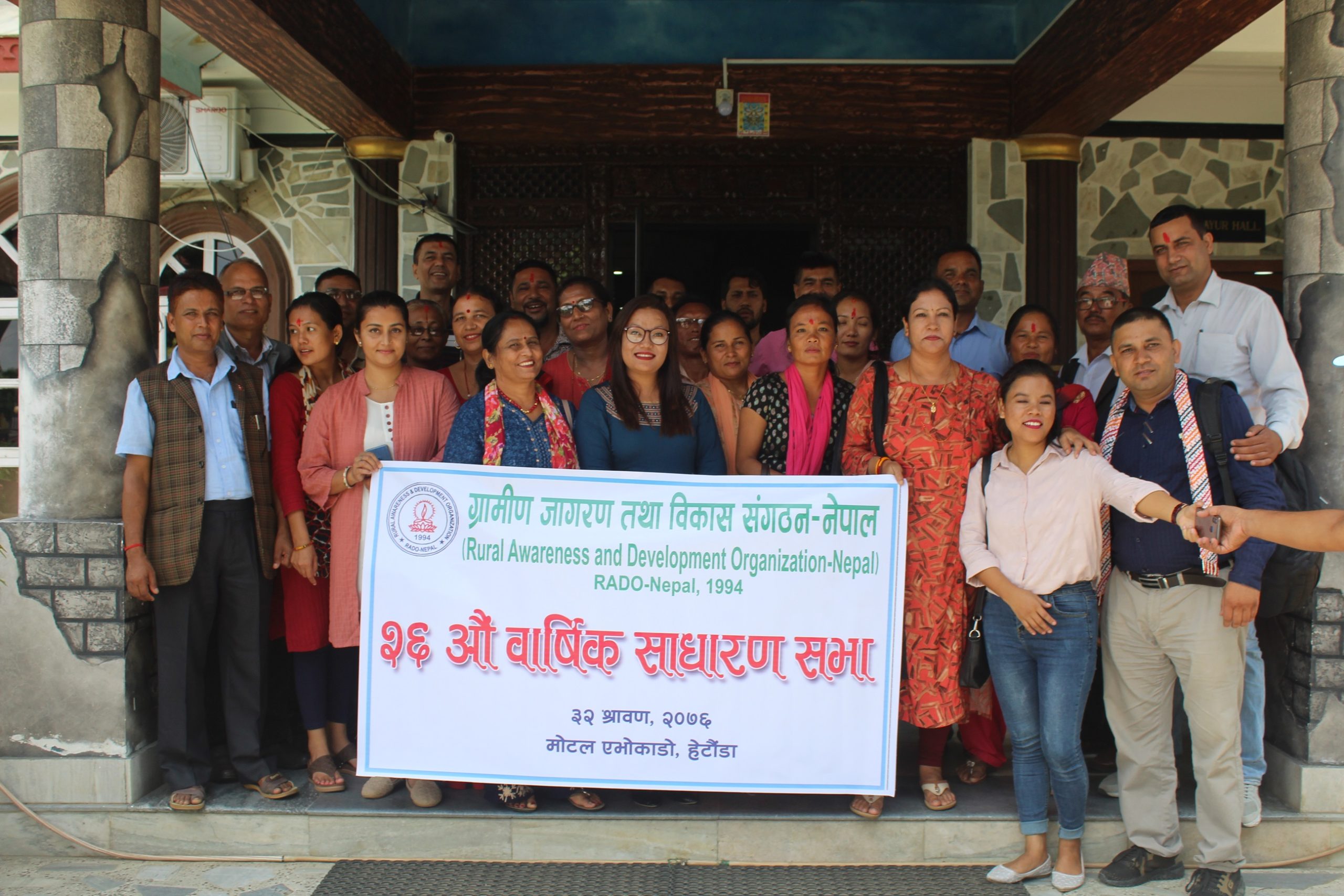
RADO-Nepal is governed by a General Assembly and an Executive Board, which is democratically elected every three years. The organization has 41 general members, with inclusive representation of 49% women, 32% Janajati, and 12% Dalit. Its nine-member Executive Board reflects this diversity, comprising 55% women, 44% Janajati, and 22% Dalit. To promote good governance, accountability, and effective duty segregation, five functional committees; Goods and Services Procurement, Account Management Committee, Goods/Inventory Management, Physical Assets Verification, and Program Monitoring and Supervision—support the Board in carrying out its mandate.
Governance:
RADO-Nepal ensures good governance through a clear organizational statute that defines its structure, roles, and responsibilities. The organization has adopted key policies and procedures on finance, procurement, human resources, safeguarding, and anti-fraud to strengthen accountability and transparency. Internal control mechanisms are in place to ensure compliance, minimize risks, and promote ethical practices. Regular board meetings, functional committees, and participatory decision-making processes enhance oversight and inclusivity. Risk management and safeguarding measures are embedded across programs to protect beneficiaries and staff. Monitoring, reporting, and external audits further reinforce trust and accountability within the organization. To strengthen its governance and internal control system, RADO-Nepal has developed and implemented a wide range of policies and guidelines, including:
- Financial Administration Policy (2001 AD / 2058 BS)
- HR Administration Policy (2001 AD / 2058 BS)
- Child Protection and Safeguarding Policy (2011 AD / 2068 BS)
- Monitoring and Evaluation (M&E) Guideline (2011 AD / 2068 BS)
- GESI Policy (2014 AD / 2071 BS)
- Complaint Handling and Management Policy (2015 AD / 2072 BS)
- Conflict of Interest Management Policy (2015 AD / 2072 BS)
- Anti-Fraud and Anti-Corruption Policy (2016 AD / 2073 BS)
- Security Policy (2016 AD / 2073 BS)
- Protection from Sexual Exploitation and Abuse Policy (2022 AD/2079 BS)
- Risk Management Policy-2022
- Health and Safety Policy-2022